
She is one of the BBC’s most famous faces and voices: Lyse Doucet, 67, has accepted the Prix Bayeux’s invitation to chair the jury’s proceedings this coming October. A “great responsibility” that the journalist, herself a winner of the 2014 Prix Bayeux, fully appreciates.
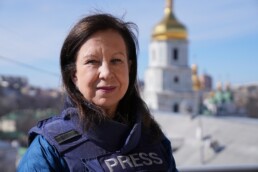
© Lee Durant
Originally from Bathurst New Brunswick, the Canadian Lyse Doucet proudly celebrates her Acadian roots through her interest in the French language and culture. However, it is in London that the journalist has been based since 1999, when she joined the BBC’s team of presenters. Her career at the British broadcaster began in 1983: aged 25, having just graduated in international relations, the young Lyse took advantage of the Canadian Crossroads International scheme to undertake a voluntary assignment that took her to West Africa. At the same time, the BBC was opening its first bureau there; she became a freelancer. “I had no experience except a few articles, no money, no contacts, no British accent. Nothing was right! But I took a risk and it worked. We used to say – “right place, right time. ” Now we say – we need to make our own luck.” For Lyse, there was no key moment, no “lightbulb moment” that made her decide to become a journalist. However, a book borrowed from the local library—for which she still has the late slip—reveals an ambition that emerged very early on. The title of the book? “How to Become a Journalist?”…
A thirst to tell stories
From freelance work, Lyse became a correspondent for the BBC. Her job – “the best in the world!” – took her to Afghanistan, Islamabad, and Iran, then to Amman and Jerusalem. Years of travel and discovery during which she learnt that “to tell a society’s story better, you have to understand it and immerse yourself in it”. Telling a society’s story, reporting the news – Lyse has made this her guiding principle. More than an ambition, it is a true way of life that she has embraced. “Being a journalist is a way of approaching life and living life.” By living in places, she builds relationships, weaves the network of contacts she lacked upon her arrival, and ultimately forges very strong bonds. “Through covering these regions, they are no longer simply news stories: they are part of our lives. Going to place again and again spending time with people, changes places into second homes. We live their history, what we often call hinterland on the story. »
Understanding, not ignoring
So deeply attached to what have become war-torn regions, Lyse naturally focuses on the plight of civilians. Her report “Yarmouk”, produced in 2013 in the besieged Syrian city, earned her a Prix Bayeux. It shows a young boy collapsing in tears amidst the ruins, starving and without hope. “I wanted to show listeners and viewers how the most savage tactics of war, like the medieval “surrender or starve” affects people living through it. I also wanted them to understand that, despite the distance, these wars were and are also ours. That a world gone wrong is not the world we all aspire to.” At the heart of these conflicts, Lyse has thus witnessed the worst, but has also sought out and seen the best in human beings. “I think many correspondents of our time try to find glimmers of light and hope because I think all of us need that in order to survive. In times of war, we must show the glimpses of humanity to get through inhumanity.”
A debut book
To show everyday life in times of war and because “headlines and news reports provide a very small snapshot about people’s lives”, Lyse Doucet has recently explored a new way of storytelling; the seasoned journalist has published her very first book, A Finest Hotel in Kabul, in which she paints a portrait of the Afghan people through the personal stories of six employees at the Kabul Intercontinental Hotel. “In this book, I tell the stories of Afghans, but it could have been the people of Gaza, Sudan, Ukraine, people living through grevious wars. In times like this, people have to find ways to get up every day and face the day. In times of war, not only does life go on, but it must go on, because people hold on to whatever is left of their lives, if they can.” From this new experience as an author, which she describes as “positive and gratifying”, Lyse emerges “all the more convinced that the work of journalism, of storytelling writ large, is ever so important in our time: not just the stories we tell, but how we tell them”.
Madam President
And how do we tell the story of what is happening in the world in the age of artificial intelligence and social media? She intends to put this question on the agenda of the next Bayeux Calvados-Normandy Award fo War Correspondents, where she will chair the jury. Eager to reunite with her colleagues and friends, to honour the memory of those whose names are engraved on the Reporters’ Memorial, and to engage with the younger generation, Lyse Doucet is preparing very seriously for her role as President. “Winning an award from your own tribe is very special. I know this because I’ve experienced it myself. So I am fully aware of this great responsibility. ” The discussions promise to be rich this autumn in the small French town that foreigners awkwardly pronounce as “Bayou”. Lyse Doucet finds this very amusing! “Bayou, it’s like a bijou, isn’t it?! Bayou, our little bijou! ” Following Ed Vuliamy’s “Oscars of Journalism”, “Bayou, the little bijou of war correspondents” is preparing to welcome one of journalism’s finest gem. A shared honour.
SOME DATES